Finger Jointing vs Traditional Wood Joining: Which Is Stronger?
Wood joining methods determine far more than just how two pieces of timber are attached — they directly affect the structural strength, durability, and consistency of the final product. For decades, traditional joining methods such as butt joints, scarf joints, and simple glue lamination were the standard across the woodworking industry. Finger jointing has since emerged as a dominant modern alternative, particularly for manufacturers producing solid wood panels, furniture components, and construction-grade timber at scale. This blog breaks down how each method actually performs, so you can decide which is right for your production line.
What Is Traditional Wood Joining?
Traditional wood joining methods rely on simpler geometries to connect two pieces of timber. Common examples include:
- Butt Joint – two flat wood ends glued directly together, offering minimal surface contact
- Scarf Joint – an angled cut joining two pieces, increasing surface area over a butt joint
- Lap Joint – overlapping sections of wood joined together, common in framing applications
- Dowel Joint – wooden pegs inserted into drilled holes to align and reinforce the connection
These methods are simple, require minimal equipment, and have been used reliably for generations — but they generally offer a smaller glue-contact surface area, which directly limits the strength of the resulting joint.
What Is Finger Jointing?
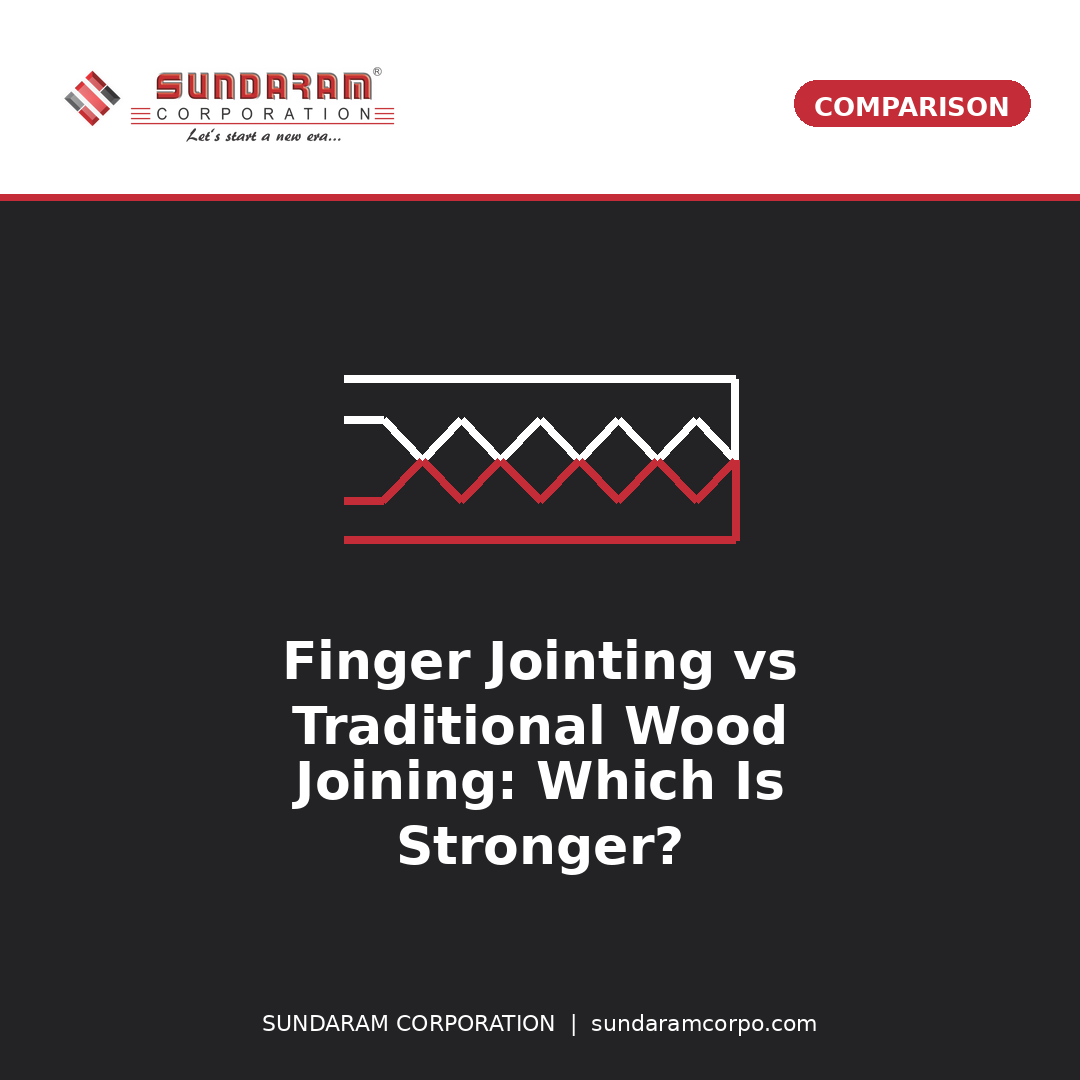
Finger jointing uses a series of interlocking, finger-shaped cuts machined into the ends of two wood pieces, which are then glued and pressed together. The interlocking fingers dramatically increase the surface area available for adhesive bonding compared to a flat butt joint, and the mechanical interlock itself adds structural strength beyond what glue alone provides.
Strength Comparison: Surface Area and Bonding
The core reason finger joints outperform traditional butt or lap joints in strength comes down to surface area. A finger joint’s interlocking profile can offer significantly more glue-contact surface than a flat joint of the same wood width, allowing the adhesive bond to distribute stress across a much larger area rather than concentrating it at a single flat interface. This translates into a joint that resists both tension and bending stress far more effectively.
Consistency Across Production Runs
Traditional joining methods, especially when done manually, are subject to variation based on operator skill, cut precision, and glue application consistency. Finger jointing, when done using a properly calibrated finger jointing machine and finger cutting machine, produces highly consistent joint geometry across every piece, which means predictable strength and quality across large production volumes — a critical factor for manufacturers supplying construction-grade or export-quality timber.
Material Utilization and Waste Reduction
Finger jointing allows manufacturers to join shorter offcuts and lower-grade sections of timber into longer, structurally sound pieces, significantly reducing wood wastage compared to relying solely on longer, defect-free boards for traditional joining. This makes finger jointing not just a strength advantage, but also a material efficiency advantage — an increasingly important factor as timber costs rise.
Where Traditional Joining Still Has a Place
Traditional joining methods remain relevant for smaller workshops, custom furniture pieces where the joint itself is a visible design feature, and applications where investment in dedicated finger jointing machinery isn’t yet justified by production volume. For low-volume, artisanal, or design-forward work, traditional methods can still deliver adequate strength with lower equipment investment.
When Finger Jointing Is the Clear Choice
- High-volume solid wood panel or furniture component production
- Structural or load-bearing timber applications
- Manufacturers looking to reduce wood wastage from shorter offcuts
- Export-quality production requiring consistent joint strength across large batches
- Pallet and construction timber manufacturing where joint reliability is critical
The Role of Machine Quality in Finger Joint Strength
It’s worth noting that finger jointing’s strength advantage depends heavily on the precision of the cutting and pressing equipment used. A poorly calibrated finger cutting machine or finger joint press machine can produce inconsistent finger profiles or insufficient press pressure, undermining the very strength advantage that makes finger jointing valuable in the first place. This makes machine quality and calibration just as important as the joining method itself.
How Sundaram Corporation Supports Finger Jointing Production
Sundaram Corporation manufactures a complete finger jointing line — including finger cutting machines and finger joint press machines — engineered for consistent, high-strength joints across high-volume production. Our machines are built and calibrated in-house at our Ahmedabad facility, backed by after-sales support for manufacturers scaling up their solid wood processing capacity.