Multi Plank Rip Saw vs Panel Saw: Complete Comparison
Introduction
Choosing the right cutting machine is one of the most important decisions for any woodworking business. Whether you manufacture furniture, wooden doors, cabinets, flooring, panels, or construction timber, selecting the appropriate machine directly impacts production speed, cutting accuracy, material utilization, and overall profitability.
Among the most widely used woodworking machines are the Multi Plank Rip Saw and the Panel Saw. While both are designed to process wood efficiently, they serve different purposes and are built for different cutting applications. Understanding the differences between these machines helps manufacturers invest in equipment that matches their production requirements.
A Multi Plank Rip Saw is designed for high-speed longitudinal cutting, allowing multiple boards or a single wide board to be ripped into several strips simultaneously. In contrast, a Panel Saw is engineered for accurate cross-cutting and sizing of large wood panels such as plywood, MDF, particle board, laminated sheets, and engineered wood products.
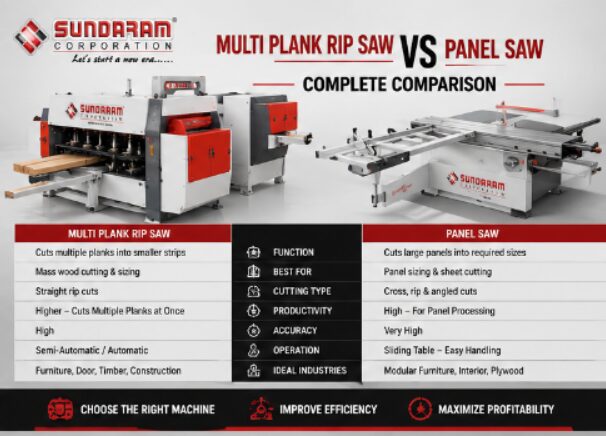
This guide provides a detailed comparison between Multi Plank Rip Saws and Panel Saws, highlighting their working principles, applications, advantages, limitations, and the factors to consider before making a purchase.
What Is a Multi Plank Rip Saw?
A Multi Plank Rip Saw is a high-production woodworking machine that cuts timber lengthwise (along the grain) using multiple circular saw blades mounted on a single shaft. It enables manufacturers to divide one board into multiple strips in a single pass, significantly increasing productivity.
These machines are commonly used in:
- Furniture manufacturing
- Wooden flooring production
- Door and window manufacturing
- Timber processing
- Pallet production
- Construction timber preparation
- Solid wood component manufacturing
The primary objective of a Multi Plank Rip Saw is to maximize production speed while maintaining straight and accurate rip cuts.
What Is a Panel Saw?
A Panel Saw is a precision cutting machine designed for sizing large wood-based panels into accurate dimensions. It uses one or more circular saw blades to cut sheet materials with clean edges and minimal chipping.
Panel Saws are widely used for processing:
- Plywood
- MDF
- Particle board
- Laminated boards
- Veneer panels
- HDF
- Melamine-coated boards
- Decorative panels
These machines are ideal for producing cabinet parts, furniture components, shelving, wardrobes, office furniture, and modular kitchen panels.
Working Principle
Multi Plank Rip Saw
The machine feeds timber through multiple rotating saw blades positioned on the arbor. Depending on the required width, adjustable spacers determine the spacing between blades, allowing several strips to be produced in a single operation.
This process is highly efficient for continuous production of uniform wooden strips.
Panel Saw
A Panel Saw moves either the panel or the saw carriage along a programmed cutting path. Precision guides and positioning systems ensure highly accurate cuts in both longitudinal and cross directions.
Modern CNC panel saws automate cutting sequences to maximize accuracy and minimize waste.
Primary Purpose
Multi Plank Rip Saw
Designed for:
- Longitudinal ripping
- High-volume timber processing
- Producing multiple strips simultaneously
- Continuous production
Panel Saw
Designed for:
- Panel sizing
- Cross-cutting
- Precision sheet cutting
- Furniture component production
Each machine is optimized for a different type of woodworking operation.
Materials Processed
Multi Plank Rip Saw
Suitable for:
- Solid wood
- Hardwood
- Softwood
- Construction timber
- Wooden planks
- Engineered timber
Panel Saw
Suitable for:
- MDF
- Particle board
- Plywood
- Laminated panels
- Veneered boards
- Decorative sheets
- Composite wood panels
Material compatibility is one of the biggest differences between the two machines.
Cutting Direction
Multi Plank Rip Saw
Cuts wood along the grain (rip cutting).
Ideal for converting wide timber into narrower boards.
Panel Saw
Cuts across or along sheet materials depending on production requirements.
Suitable for accurate sizing of panels into finished components.
Production Speed
Production speed is a critical factor in industrial woodworking.
Multi Plank Rip Saw
Advantages include:
- Multiple cuts in one pass
- Continuous feeding
- High throughput
- Fast timber processing
- Excellent productivity
These machines are ideal for large-scale production environments.
Panel Saw
Panel Saws prioritize precision over maximum cutting speed.
Although modern CNC models are highly efficient, they generally process one cutting program at a time.
Cutting Accuracy
Accuracy is essential for furniture manufacturing.
Multi Plank Rip Saw
Provides:
- Straight rip cuts
- Consistent strip widths
- Good dimensional accuracy
Accuracy depends on blade setup and machine alignment.
Panel Saw
Offers:
- Exceptional dimensional precision
- Accurate angles
- Smooth edges
- Minimal chipping
- Excellent repeatability
Panel Saws are preferred for applications requiring high precision.
Material Utilization
Reducing material waste improves manufacturing profitability.
Multi Plank Rip Saw
Optimizes timber utilization by producing multiple strips from a single board.
Proper blade spacing helps maximize yield.
Panel Saw
Uses cutting optimization software to reduce waste when processing large panels.
Advanced nesting and cutting programs further improve material efficiency.
Surface Finish Quality
Multi Plank Rip Saw
Produces clean rip cuts when equipped with high-quality saw blades and proper feed rates.
Additional finishing may be required depending on the application.
Panel Saw
Delivers smooth, clean edges suitable for furniture manufacturing.
Scoring blades minimize edge chipping on laminated panels.
Automation Features
Modern woodworking machines incorporate advanced automation technologies.
Multi Plank Rip Saw
Automation may include:
- Automatic feeding systems
- Variable feed speed
- Laser alignment
- Digital width adjustment
- Automatic lubrication
Panel Saw
Automation often includes:
- CNC control
- Touchscreen operation
- Automatic panel positioning
- Barcode integration
- Cutting optimization software
- Program memory
- Servo-controlled movements
Automation improves productivity while reducing operator intervention.
Labor Requirements
Multi Plank Rip Saw
Requires minimal manual handling after setup.
Suitable for continuous production with fewer operators.
Panel Saw
Also reduces manual labor through automated positioning and programmable cutting sequences.
CNC models significantly reduce operator workload.
Maintenance Requirements
Multi Plank Rip Saw
Routine maintenance includes:
- Blade inspection
- Arbor cleaning
- Lubrication
- Bearing inspection
- Feed roller maintenance
Panel Saw
Maintenance typically involves:
- Guide rail cleaning
- Blade inspection
- Servo system checks
- Lubrication
- Software updates
- Dust extraction maintenance
Preventive maintenance improves machine reliability.
Energy Consumption
Multi Plank Rip Saw
Consumes energy according to:
- Number of blades
- Motor size
- Feed speed
- Timber density
Panel Saw
Energy usage depends on:
- Machine size
- Servo systems
- Panel dimensions
- Cutting cycles
Modern machines in both categories are designed with energy-efficient motors and optimized drive systems.
Applications
Multi Plank Rip Saw Applications
- Furniture components
- Wooden flooring
- Timber processing
- Door manufacturing
- Window frame production
- Wooden pallets
- Construction lumber
- Wooden battens
- Packaging materials
Panel Saw Applications
- Modular kitchens
- Office furniture
- Wardrobes
- Cabinets
- Shelving
- Display units
- Decorative wall panels
- Interior furniture
- Educational furniture
Each machine serves a distinct role in woodworking production.
Advantages of Multi Plank Rip Saw
- High production speed
- Multiple cuts in one pass
- Excellent timber utilization
- Reduced labor costs
- Continuous operation
- High productivity
- Strong return on investment
- Suitable for mass production
Advantages of Panel Saw
- Exceptional cutting precision
- Excellent edge quality
- Accurate panel sizing
- Reduced material waste
- Easy integration with CNC systems
- Suitable for customized production
- Ideal for furniture manufacturing
- Flexible programming options
Limitations of Multi Plank Rip Saw
- Designed primarily for rip cutting
- Not suitable for large sheet materials
- Blade setup requires precision
- Limited flexibility for irregular cutting patterns
Limitations of Panel Saw
- Lower throughput for continuous timber ripping
- Higher investment for advanced CNC models
- Requires accurate programming
- Less suitable for processing solid timber into multiple narrow strips
Which Machine Should You Choose?
The choice depends on your manufacturing requirements.
Choose a Multi Plank Rip Saw if your business focuses on:
- Solid wood processing
- High-volume timber ripping
- Flooring production
- Wooden strip manufacturing
- Construction timber
- Pallet production
Choose a Panel Saw if your production involves:
- Furniture manufacturing
- Cabinet production
- Modular kitchens
- MDF processing
- Plywood cutting
- Laminated boards
- Precision panel sizing
Some large woodworking factories use both machines together—Multi Plank Rip Saws for processing solid timber and Panel Saws for cutting engineered wood panels—creating a highly efficient and versatile production line.
Key Factors to Consider Before Buying
Before investing in either machine, evaluate the following:
- Production volume
- Type of material processed
- Required cutting accuracy
- Machine automation level
- Motor power
- Blade quality and compatibility
- Feed system efficiency
- Dust extraction capability
- Energy consumption
- Maintenance requirements
- Workshop space
- Availability of spare parts
- Technical support and after-sales service
- Future production expansion plans
Selecting the right machine based on your production goals will improve efficiency, reduce operating costs, and ensure consistent product quality for years to come.