How Finger Joint Machines Increase Production Efficiency
Introduction
The woodworking and furniture manufacturing industries have evolved significantly with the adoption of advanced machinery and automation. One of the most important innovations that has transformed wood processing is the finger joint machine. Designed to join shorter pieces of timber into longer, stronger, and more usable lengths, finger joint machines help manufacturers maximize raw material utilization, reduce waste, and improve overall production efficiency.
From furniture factories and flooring manufacturers to door, window, and panel production units, finger joint technology has become an essential part of modern woodworking. By creating precise interlocking joints that offer exceptional strength and durability, these machines allow businesses to produce high-quality wood products while minimizing production costs.
As competition increases and demand for sustainable manufacturing grows, investing in a high-performance finger joint machine has become a strategic decision for woodworking businesses looking to improve productivity and profitability.
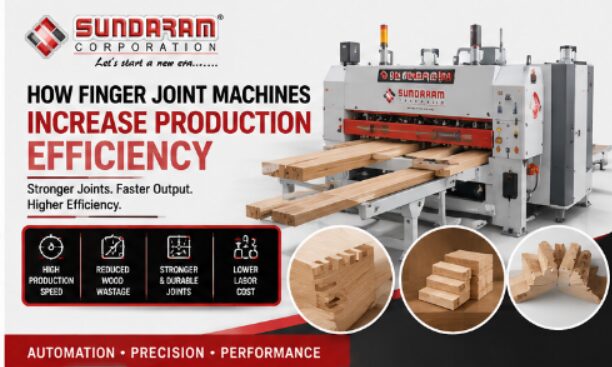
What Is a Finger Joint Machine?
A finger joint machine is a specialized woodworking machine used to join two or more shorter pieces of wood by cutting a series of interlocking “finger-shaped” profiles at each end. These profiles are coated with adhesive and then pressed together under controlled pressure to form a strong, durable joint.
The resulting timber behaves much like a single continuous piece of wood, making it suitable for a wide range of applications where longer lengths and structural stability are required.
Finger joint machines are commonly used in:
- Furniture manufacturing
- Door production
- Window frame manufacturing
- Flooring industries
- Panel manufacturing
- Construction timber production
- Interior decoration
- Modular furniture manufacturing
Why Production Efficiency Matters
In today’s competitive manufacturing environment, production efficiency directly impacts profitability, product quality, and customer satisfaction.
Efficient production helps businesses:
- Reduce manufacturing costs
- Increase production capacity
- Improve delivery schedules
- Minimize material waste
- Enhance product consistency
- Lower labor costs
- Maximize machine utilization
- Increase return on investment
Finger joint machines contribute significantly to achieving these goals.
Maximizes Raw Material Utilization
One of the biggest advantages of finger joint technology is its ability to utilize shorter pieces of timber that would otherwise be discarded.
Instead of wasting offcuts, manufacturers can join them together to create longer, usable boards.
This helps:
- Reduce wood waste
- Lower raw material costs
- Increase timber yield
- Improve sustainability
- Maximize inventory utilization
Efficient use of timber directly improves production economics.
Reduces Material Waste
Traditional woodworking often generates a considerable amount of waste due to size limitations and defects.
Finger joint machines allow manufacturers to remove only the defective sections while preserving the remaining usable wood.
Common defects removed include:
- Knots
- Cracks
- Splits
- Decayed sections
- Warped portions
- Surface imperfections
Only damaged portions are eliminated, allowing the remaining timber to be reused effectively.
Produces Longer Timber Sections
Many furniture and construction applications require long wooden components.
Finger joint machines make it possible to produce longer boards from smaller timber pieces.
Applications include:
- Door frames
- Window frames
- Wooden beams
- Cabinet components
- Furniture panels
- Flooring planks
- Decorative moldings
This flexibility expands manufacturing capabilities without increasing raw material consumption.
Improves Production Speed
Manual joining methods require significant labor and time.
Modern finger joint machines automate the entire process, including:
- End profiling
- Adhesive application
- Alignment
- Pressing
- Joint formation
Automation significantly increases production speed while maintaining consistent quality.
Higher throughput enables manufacturers to fulfill larger orders more efficiently.
Ensures Consistent Joint Quality
Precision machining produces identical finger profiles every time.
This consistency offers several advantages:
- Uniform joint strength
- Better dimensional accuracy
- Improved product appearance
- Reduced rejection rates
- Reliable production quality
Automated accuracy minimizes variations that commonly occur with manual processes.
Increases Structural Strength
Properly manufactured finger joints often provide excellent mechanical strength.
The interlocking finger design increases the bonding surface area, resulting in durable joints capable of handling demanding applications.
Benefits include:
- Higher tensile strength
- Better load distribution
- Improved dimensional stability
- Long-lasting performance
- Reduced risk of separation
Strong joints improve the overall quality of finished products.
Supports High-Volume Manufacturing
Large furniture factories require continuous production with minimal interruptions.
Finger joint machines are designed for:
- Continuous operation
- High production capacity
- Fast cycle times
- Automated workflows
- Reliable performance
These capabilities make them ideal for industrial-scale woodworking operations.
Reduces Labor Requirements
Automation significantly decreases manual handling.
Operators mainly supervise the process while the machine performs:
- Profiling
- Feeding
- Adhesive application
- Pressing
- Joint alignment
Lower labor requirements help manufacturers reduce operational costs while improving productivity.
Enhances Product Quality
Precision manufacturing results in superior finished products.
High-quality finger joints contribute to:
- Smooth surfaces
- Better finishing
- Improved appearance
- Stronger furniture components
- Consistent dimensions
Quality improvements increase customer satisfaction and reduce warranty claims.
Improves Workflow Efficiency
Finger joint machines integrate easily with other woodworking equipment.
They can operate alongside:
- Cross-cut saws
- Four-side planers
- CNC routers
- Sanding machines
- Press systems
- Automatic stacking equipment
This integration creates a streamlined production line with fewer bottlenecks.
Supports Sustainable Manufacturing
Efficient timber utilization contributes to environmentally responsible production.
Benefits include:
- Lower wood consumption
- Reduced landfill waste
- Better forest resource management
- Reduced environmental impact
- Improved sustainability practices
Many manufacturers adopt finger joint technology as part of their green manufacturing initiatives.
Reduces Production Costs
Lower material waste and increased automation translate directly into cost savings.
Manufacturers benefit from:
- Reduced raw material expenses
- Lower labor costs
- Less rework
- Improved machine utilization
- Higher production output
- Better profit margins
Over time, these savings can provide an excellent return on investment.
Delivers Accurate and Repeatable Results
Modern finger joint machines use precision cutting systems that ensure every joint is produced to exact specifications.
This repeatability helps manufacturers maintain:
- Uniform product dimensions
- Reliable assembly
- Improved machining accuracy
- Consistent adhesive distribution
Repeatable production reduces errors and increases operational efficiency.
Compatible with Various Wood Species
Finger joint machines can process a wide variety of timber types.
Common materials include:
- Pine
- Rubberwood
- Teak
- Oak
- Maple
- Ash
- Beech
- Spruce
- Cedar
- Engineered wood
This versatility allows manufacturers to serve diverse market requirements.
Increases Production Flexibility
Modern machines can accommodate different:
- Board lengths
- Widths
- Thicknesses
- Joint profiles
- Production volumes
Manufacturers can quickly adapt to changing customer requirements without extensive setup changes.
Improves Adhesive Bonding
Precision-machined finger profiles provide a large bonding surface.
Advantages include:
- Strong adhesive penetration
- Better load distribution
- Reliable joint integrity
- Long-lasting performance
Proper adhesive application contributes significantly to production quality.
Supports Automated Production Lines
Many modern finger joint machines include advanced automation features such as:
- Automatic feeding systems
- Servo-controlled positioning
- Digital control panels
- Programmable cutting parameters
- Automatic pressing
- Production monitoring
Automation reduces operator intervention while improving efficiency.
Reduces Machine Downtime
High-quality finger joint machines are designed for reliable operation.
Features such as:
- Heavy-duty construction
- Precision bearings
- Durable cutters
- Robust frames
- Efficient lubrication systems
help reduce maintenance requirements and minimize unexpected production interruptions.
Improves Inventory Management
Instead of storing large quantities of long timber, manufacturers can efficiently utilize shorter stock.
This provides:
- Better warehouse utilization
- Reduced inventory costs
- Easier material handling
- Improved stock rotation
Efficient inventory management supports lean manufacturing practices.
Enhances Worker Safety
Modern finger joint machines incorporate advanced safety features, including:
- Emergency stop systems
- Safety guards
- Automatic clamping
- Sensor-based protection
- Overload protection
- Dust extraction compatibility
These features help create a safer working environment while maintaining high production rates.
Industries That Benefit from Finger Joint Machines
Finger joint technology is widely used in:
- Furniture manufacturing
- Wooden door production
- Window frame manufacturing
- Flooring production
- Construction timber processing
- Modular furniture manufacturing
- Kitchen cabinet production
- Interior decoration
- Wooden packaging
- Engineered wood manufacturing
Each of these industries benefits from improved productivity, stronger joints, and reduced production costs.
Key Factors When Choosing a Finger Joint Machine
To maximize production efficiency, businesses should evaluate:
- Machine capacity
- Cutting precision
- Production speed
- Automation level
- Adhesive application system
- Pressing force
- Compatibility with different wood species
- Energy efficiency
- Ease of maintenance
- Availability of spare parts
- After-sales service and technical support
Selecting the right machine ensures long-term reliability, consistent quality, and higher manufacturing efficiency.