Why Every Solid Wood Factory Needs a Finger Cutting & Press Machine in 2026
In the competitive landscape of 2026, the solid wood industry is facing a dual challenge: rising raw material costs and a growing demand for sustainable, high-quality timber products. For factory owners, the difference between a profitable year and a stagnant one often comes down to yield.

If your factory is still discarding short timber off-cuts or struggling with the structural instability of long planks, you are leaving money on the workshop floor. Here is why investing in a Finger Cutting and Joint Press Machine is no longer optional—it is a strategic necessity for 2026.
- Transforming Waste into Premium Inventory
Historically, short pieces of wood (anything under 2-3 feet) were treated as “scrap” or sold cheaply as firewood. In 2026, where high-grade timber prices are at an all-time high, this waste is a massive leak in your revenue.
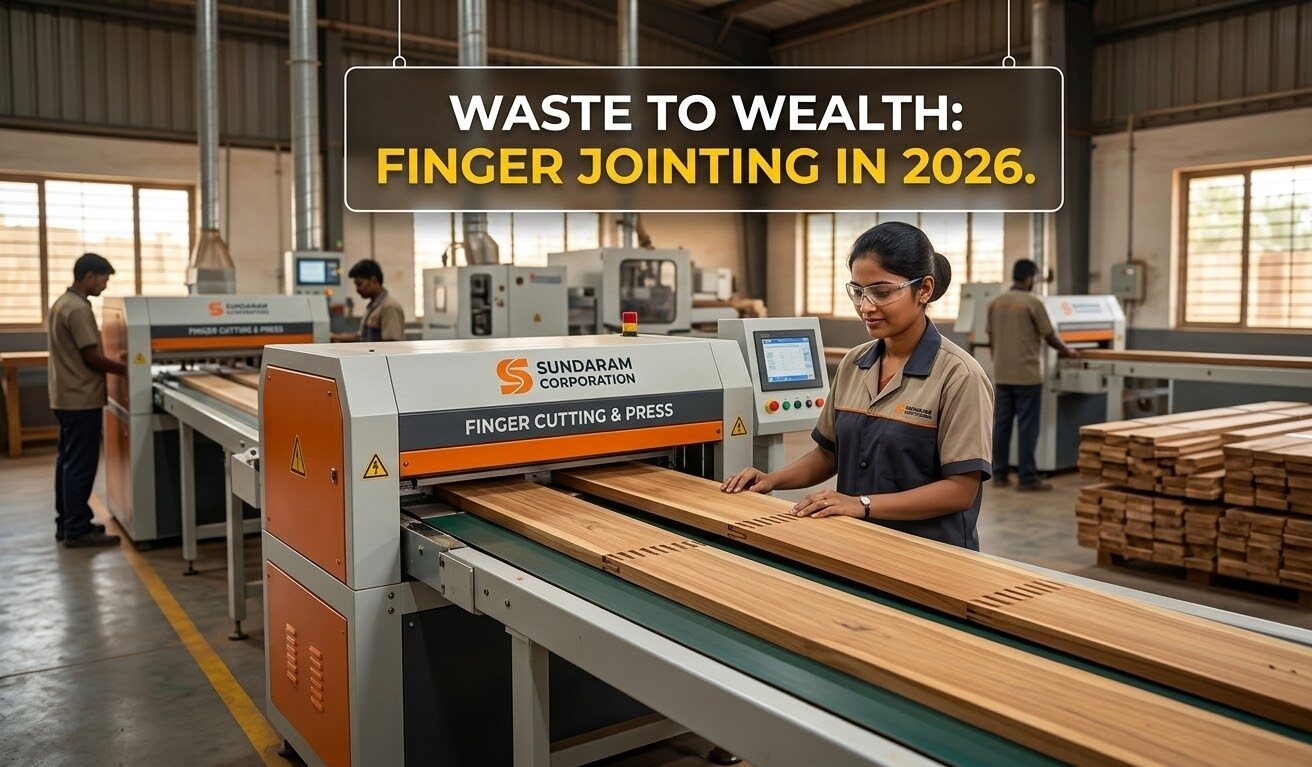
A Finger Cutting Machine creates high-precision interlocking “fingers” at the ends of these short pieces. Once the Joint Press applies high-pressure adhesive bonding, these scraps become long, high-value structural boards. You aren’t just recycling; you are manufacturing inventory out of thin air.
- Unmatched Structural Stability
Natural long-length timber often has a mind of its own—it warps, twists, and bows due to internal grain tension.
Finger-jointed wood is scientifically proven to be more stable. Because the grain direction is broken up by the joints, the internal stresses of the wood are neutralized.
- No Warping: Perfect for door frames, window sections, and staircase railings.
- Uniform Strength: The glue bond in a finger joint is often stronger than the wood itself.
- Meeting the “Green” Demand
The 2026 consumer is obsessed with sustainability. Large-scale furniture exporters and interior contractors now demand “certified sustainable” or “zero-waste” manufacturing processes.
Using a Finger Jointing line allows your brand to market itself as an Eco-Friendly Manufacturer. By utilizing up to 95% of every log that enters your factory, you reduce your carbon footprint and appeal to the premium, environmentally-conscious market.
- Precision at Scale: Automation vs. Manual Labor
The latest 2026 models from Sundaram Corporation have moved beyond basic mechanics. Modern Finger Cutting and Press machines offer:
- High-Speed Throughput: Processing hundreds of joints per hour.
- Auto-Gluing Systems: Ensuring the exact amount of adhesive is applied, reducing mess and waste.
- Hydraulic Precision: Ensuring the press is perfectly square, so your final boards require minimal sanding.
- Overcoming the Skilled Labor Shortage
One of the biggest hurdles for Indian factories in 2026 is finding highly skilled carpenters who can perform complex joinery by hand. A Finger Jointing machine simplifies the process. With minimal training, an operator can produce joints that are more precise and consistent than those made by a master craftsman using manual tools. This consistency is what allows you to scale your business.
The Bottom Line: ROI in Months, Not Years
When you calculate the cost of the timber you currently discard, multiplied by the premium price of long-length boards, the ROI (Return on Investment) for a Finger Cutting and Press machine usually lands within 8 to 14 months.
As we move further into 2026, the factories that thrive will be those that prioritize efficiency, sustainability, and technology. Sundaram Corporation’s range of Finger Jointing solutions is designed specifically to help Indian manufacturers dominate this space.