
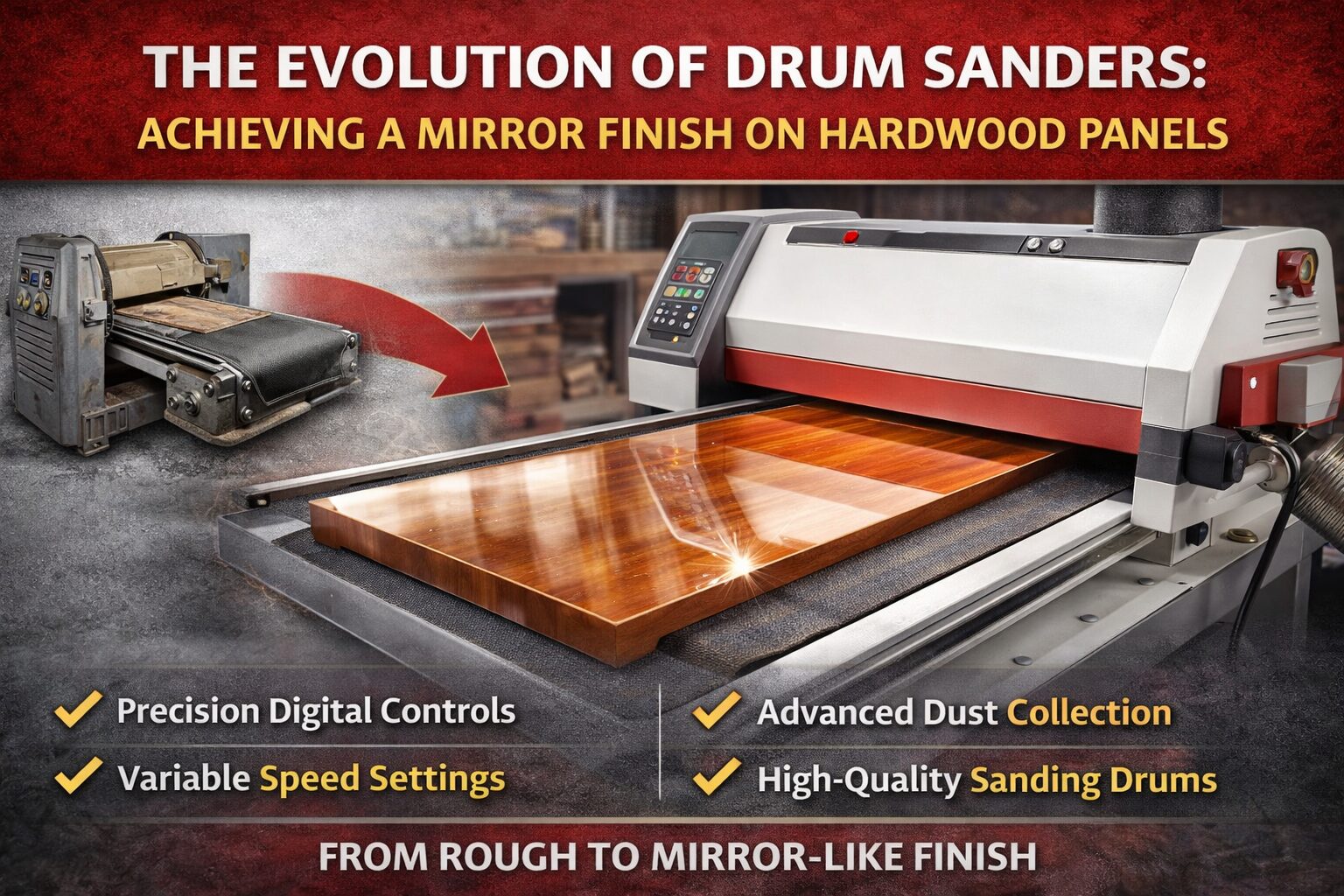
The Evolution of Drum Sanders: Achieving a Mirror Finish on Hardwood Panels
In the competitive world of high-end furniture and architectural paneling, a good finish is everything. It is the signature of a master craftsman and the metric by which a luxury panel is judged. For years, achieving that flawless “mirror finish”—a surface so smooth it looks like polished liquid—required days of laborious hand-sanding with progressively finer grits.

Today, the industrial woodworking landscape in Ahmedabad has changed. The Drum Sander has evolved from a simple dimensioning tool into a precision machine capable of handling the final, delicate stage of finishing on hardwood panels. Here is how that evolution happened, and how you can harness it to achieve the perfect finish.
- Dimensional Sanding vs. Finish Sanding: A Crucial Distinction
In the past, drum sanders were bulky workhorses designed for heavy material removal. They were used to dimension planks, removing millimeters of thickness quickly. They were powerful, but they lacked finesse. They often left deep scratch patterns (oscillations) that made a high-gloss finish impossible without significant subsequent manual sanding.
The shift to “Finish Sanding” was driven by two technological advances:
- 精密平衡Arbors (Spindles): Modern drum sanders utilize dynamically balanced arbors that eliminate all internal vibration, preventing the “ripple” effect that used to ruin panel surfaces.
- Variable Speed Feed: This is the game-changer. Finishing demands control over dwell time—how long the abrasive is in contact with the wood.
- The Mechanics of Precision: The Finishing Workflow
achieving a mirror finish requires a dedicated three-stage sanding workflow. Each step builds upon the last:
Stage 1: Calibration (80–120 Grit) The panel must first be brought to perfectly uniform thickness across its entire width. Any thickness variations will prevent the subsequent finishing passes from contacting the entire surface. This stage uses coarse abrasives to make the panel truly flat.
Stage 2: Preparation (150–220 Grit) Once the panel is flat, we begin the preparation phase. This stage aims to remove all coarse scratch marks left during calibration. This is where modern variables like feed speed and drum tension are critical.
- Pro Tip: In 2026, we are utilizing Segemented Platen technology. This system uses pneumatic pistons to apply varied pressure across the panel’s width, compensating for slight density differences in the wood (like knots vs. sapwood).
Stage 3: The Finishing Polish (320–600+ Grit) This final step is not about dimensioning; it is about polishing. We utilize ultra-fine abrasives on a soft, padded drum (to prevent burning) at a highly controlled, slow feed rate. The machine must be meticulously clean—even a speck of coarse grit that drifts onto the finishing drum will cause a surface scratch.
- Humidity and Material: The Unseen Finisher
The evolution of the drum sander is not just about metal and motors; it’s about control. Achieving a mirror finish on a hardwood like Teak or Rosewood in a monsoon-affected region like Gujarat is extremely difficult because wood moves with humidity.
Modern sanding facilities now feature integrated climate control, and the latest Sundaram machines are equipped with Digital Thickness Readouts and sensors that can adjust the machine setting by 0.1mm on the fly. We sand the panel, then instantly measure it with a laser micrometer, and the next pass is adjusted automatically.
[Image showing a laser measurement sensor on a wide-belt drum sander]
- Integration: The “Finish” as a Final Act
The drum sander is no longer an isolated machine. In a modern 2026 high-volume production line, the finishing process is integrated:
- Workflow: Wide-Belt Sander (Dimensioning) -> Drum Sander (Calibrating) -> Membrane Vacuum Press (For 3D profiles) -> Final Polish Sander (Mirror Finish).
The drum sander provides the perfectly consistent, flaw-free flat surface that all subsequent high-gloss coatings, lacquers, or vacuum presses require.