Semi-Automatic vs Fully Automatic Membrane Vacuum Press Machine
Introduction
In modern furniture manufacturing and PVC lamination operations, membrane vacuum press machines are indispensable. They help apply decorative films (PVC, PU, etc.) seamlessly onto substrates like MDF, plywood, and particle board. But when it comes to choosing the right machine, the debate often narrows to:
➡️ Semi-Automatic Membrane Vacuum Press Machine
vs
➡️ Fully Automatic Membrane Vacuum Press Machine
Both have their merits — but the choice depends on your production requirements, budget, and workflow. In this guide, we’ll help you understand the key differences with practical insights and buying tips.
What Is a Semi-Automatic Membrane Vacuum Press Machine?
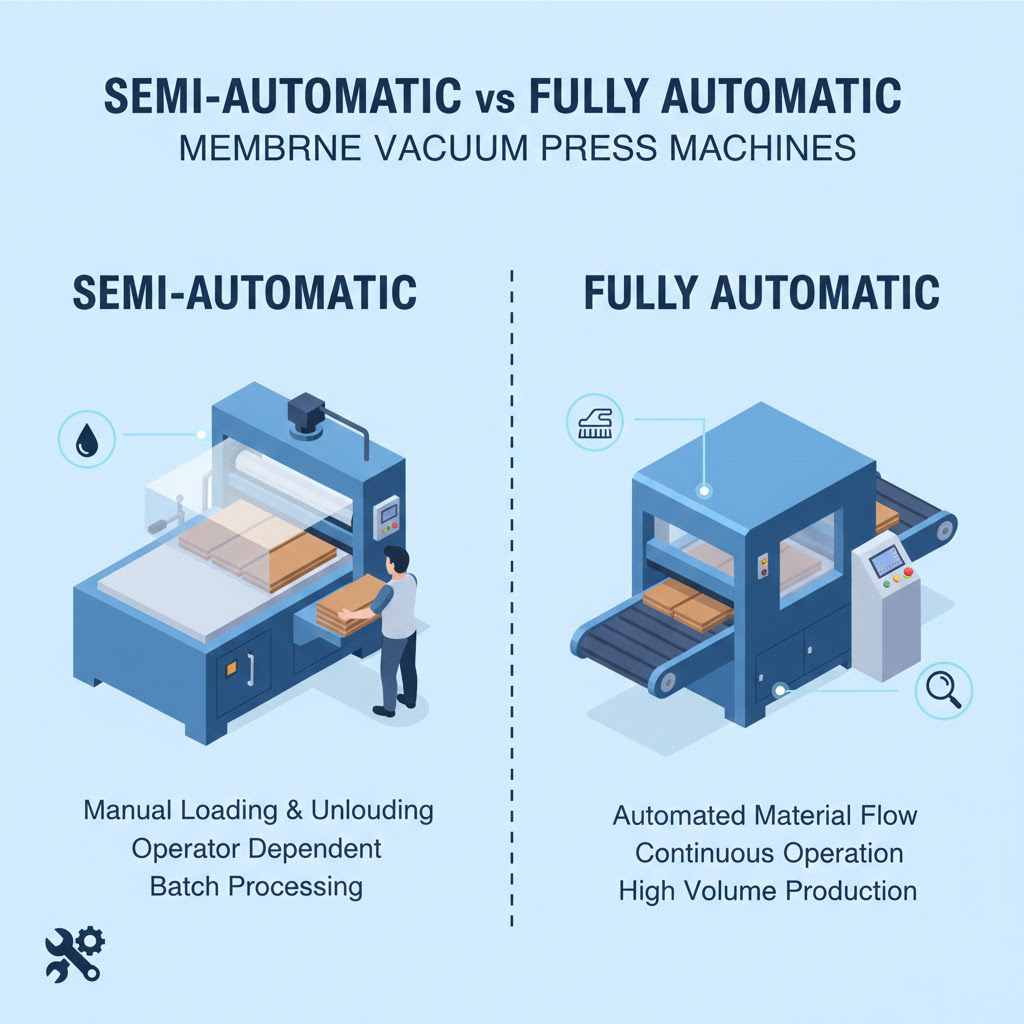
A semi-automatic membrane vacuum press machine requires manual involvement in key stages of operation, such as placing materials, aligning film, or initiating the pressing cycle. While it uses vacuum and heat technology to ensure smooth lamination, human input is still essential at multiple steps.
What Is a Fully Automatic Membrane Vacuum Press Machine?
A fully automatic membrane vacuum press machine automates most or all stages of the vacuum pressing process — from feeding panels and film alignment to pressing, heating, and unloading. This drastically reduces manual handling and enhances consistency.
Head-to-Head Comparison
| Feature | Semi-Automatic | Fully Automatic |
| Level of Automation | Partial | Complete |
| Manual Intervention | Required | Minimal |
| Production Speed | Moderate | High |
| Operator Skill Required | Higher | Lower |
| Cycle Consistency | Good | Excellent |
| Labor Cost | Lower initial | Higher initial but lower recurring |
| Precision & Repeatability | Good | Superior |
| Suitable For | Small to mid-size workshops | Large factories & high volume |
| Investment Cost | Lower | Higher |
Key Differences Explained
1️⃣ Automation & Workflow
- Semi-Automatic: Operators manually load boards and films, set parameters, then initiate the pressing cycle.
- Fully Automatic: The machine handles feeding, alignment, pressing, and can even stack finished panels — reducing human errors.
Winner (Automation): Fully Automatic
2️⃣ Production Speed & Throughput
- Semi-Automatic: Best for low to medium production — around a few dozen boards per shift.
- Fully Automatic: Designed for large output — up to hundreds of boards daily with stable cycle times.
Winner (Speed): Fully Automatic
3️⃣ Labor Requirement & Skill
- Semi-Automatic: Needs skilled operators for alignment and timing.
- Fully Automatic: Requires fewer operators and less precision handling.
Winner (Ease of Operation): Fully Automatic
4️⃣ Investment Cost
- Semi-Automatic: Lower upfront investment — ideal for startups or small businesses.
- Fully Automatic: Higher initial cost, but quicker ROI in high volume environments.
Winner (Cost-Effective for Small Units): Semi-Automatic
Winner (Long-Term Industrial ROI): Fully Automatic
Which One Should You Choose?
🛠 For Small & Medium Workshops
Choose a Semi-Automatic Machine if:
✅ You’re producing customized or low-volume orders
✅ Manual control and flexibility matter
✅ Your budget is limited
✅ You’re still scaling your manufacturing setup
🏭 For High Volume Factories
Choose a Fully Automatic Machine if:
✅ You have a large production line
✅ Consistency and speed are priorities
✅ You want labor cost savings long-term
✅ You need reduced errors and high precision output
Real-World Scenarios
📌 Example 1: A modular kitchen manufacturer with changing panel sizes and designs may prefer semi-automatic flexibility.
📌 Example 2: A large OEM furniture maker with high repeat orders and tight delivery schedules benefits more from a fully automatic system.
Maintenance and Service Considerations
| Aspect | Semi-Automatic | Fully Automatic |
| Maintenance Frequency | Medium | High |
| Spare Parts Cost | Moderate | Higher |
| Technical Support Need | Medium | Higher |
Fully automatic machines often have more components and controllers — which may lead to higher maintenance complexity, but professional servicing ensures reliability.