Multi Plank Ripsaws: How to Achieve Consistent Strips for High-Volume Manufacturing
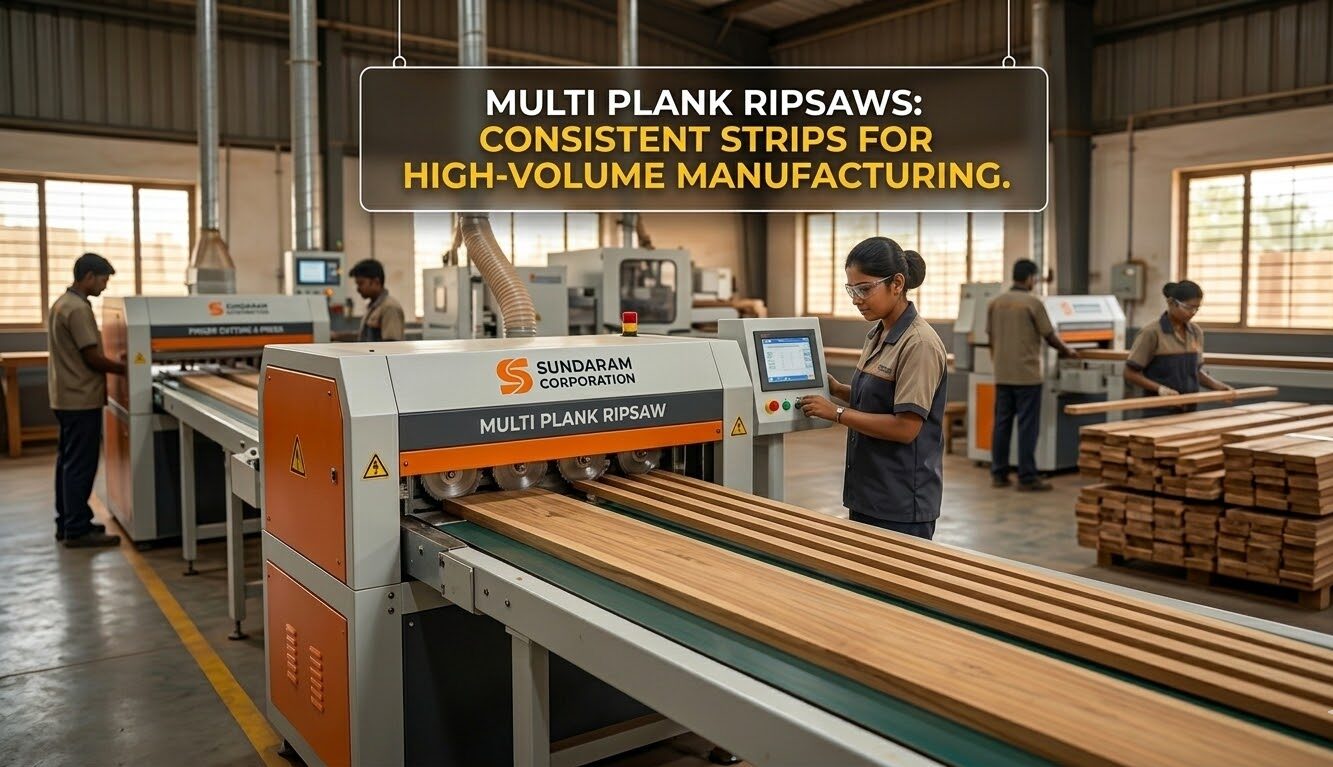
In the world of mass-scale woodworking—whether you are producing finger-jointed boards, pallets, or wall panels—speed is only half the battle. The real challenge is consistency. If your strips vary by even a millimeter, your downstream processes (like sanding, gluing, or assembly) will suffer from delays and material waste. This is where the Multi Plank Ripsaw becomes the heartbeat of your production line. In this guide, we explore how to master this machine to achieve perfect, consistent strips every time.
- The Core Advantage: Parallel Precision
A standard table saw or single-blade ripsaw requires multiple passes to create strips, increasing the margin for human error. A Multi Plank Ripsaw uses a single arbor (spindle) equipped with multiple circular saw blades separated by precision-ground spacers.
Why this matters for 2026:
- One Pass, Multiple Strips: You can turn a wide plank into 5, 8, or 10 identical strips in a single feed.
- Identical Widths: Because the blades are locked into position by fixed spacers, every strip is mathematically identical to the next.
- Setting Up for Success: The Three Pillars of Consistency
To get the most out of your Sundaram Multi Plank Ripsaw, your operators should focus on these three technical areas:
- Perfect Blade Alignment & Spacing
Consistency starts with the spacer. Using high-quality, hardened steel spacers is non-negotiable.
- Pro Tip: Always clean the arbor and spacers before mounting blades. Even a tiny speck of sawdust between a blade and a spacer can cause “blade wobble,” leading to uneven cuts and “burn marks” on the wood.
- Controlled Feed Speed (The “Sweet Spot”)
High-volume manufacturing often tempts operators to crank the feed speed to the maximum. However, consistency depends on the relationship between blade RPM and feed rate.
- Too Fast: Causes the blades to deflect or heat up, leading to wavy cuts.
- Too Slow: Causes friction and burning, which damages the wood surface and dulls your blades prematurely.
- The Pressure Roller System
For a straight cut, the plank must stay perfectly flat against the machine bed. Sundaram machines utilize a heavy-duty Multi-Point Pressure Roller System. Ensure these rollers are adjusted to the thickness of your specific timber to prevent the plank from “chattering” or shifting mid-cut.
- Handling Heat: The Enemy of High Volume
When running a ripsaw for 8–10 hours a day, thermal expansion is a real threat. As blades heat up, they expand. In a multi-blade setup, this can lead to “blade flutter.”
Modern Solutions for 2026:
- Stellite-Tipped or Carbide Blades: These maintain their edge longer and handle heat better than standard steel.
- Integrated Dust Extraction: Removing sawdust immediately isn’t just about cleanliness; it’s about heat dissipation. Sawdust traps heat around the blades.
- Safety and Maintenance in High-Volume Environments
Consistency isn’t just about the first hour of the shift; it’s about the eighth.
- Anti-Kickback Fingers: Always ensure the safety fingers are moving freely. In high-volume environments, a kickback can be devastating.
- Daily Arbor Check: At the end of every shift, check the arbor for any signs of vibration or bearing wear. A vibrating arbor is the #1 cause of inconsistent strip widths.
- Integrating with Your Production Line
A Multi Plank Ripsaw shouldn’t be an island. For maximum efficiency in 2026, consider the “Sundaram Workflow”:
- Input: Wood Panel Composer or raw planks.
- Process: Multi Plank Ripsaw (for sizing).
- Output: Straight to the Finger Jointing Line or Sander.
By automating the ripping process, you eliminate the “bottleneck” that usually happens at the start of the production chain.